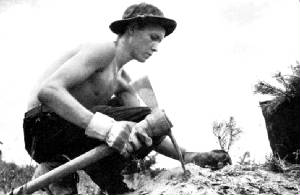
CCC enrollee James Wasson (Tell City, Indiana CCC camp) doing telephone line maintenance
"We can take it!", was originally the unofficial motto of
the United States Civilian Conservation Corps
and is the
grassroots citizens call for action
campaign to urge our Federal policy makers to create bi-partisan law to REACTIVATE the
popular New Deal public works program, the United States Civilian Conservation Corps.
Reactivation could be a solution
to combat GLOBAL WARMING!
Group photograph of the Veteran CCC Camp at Wolfcreek, Oregon
Back in time during the depths of the
Great Depression, the CCC program became the first "alphabet soup" initiative of Franklin D. Roosevelt,
our 32nd President. He envisioned temporary employment of 250,000 young men. It soon became the largest mobilization
of civilian workers and the most popular government program in American History that employed nearly 4 million Americans
put to work reclaiming the country’s natural resources.
"More important, however, than the material gains from their labors will be the moral and spiritual value of
such work." Franklin D. Roosevelt
It was remarked in many newspaper and newsreel editorials that "The primary
purpose of the program is not to get work done but to provide work for the men who need it." Nevertheless,
the program supervisors saw and prepared for this major labor source. They also provided humanitarian aid to victims of natural disasters in
congruence with the American Red Cross.
In the early years of WW2, the 77th Congress over the opposition of President Roosevelt, cut government funding to the Civilian Conservation Corps.
JIM HIGHTOWER COMMENTARY REACTIVATING THE CCC FOR NATIONAL RECOVERY
It is by far the best shovel ready program to date and would put thousands of work boots on the ground within a matter
of weeks in over a thousand camps across the country. Millions of Americans over time would give of themselves in a worthwhile work program for our environment
in public service to our nation. Similar workforces are now in action in other nations and if we brought this program
back it would be a solution here and the world over to help save lives and our planets environment from global warming.
-
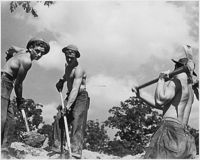
CCC enrollees using picks and shovels, Maryland, 1933
CCC maintenance work on Swan Lake Road, Colville National Forest
A Citizen's Comment
please sign the national petition below:
#
451:
May
3, 2009,Robert Richey Jr, Texas As a Houstonian I see the damage brought
on by Hurricane Ike and felt the impact of of FEMA's response. Please let a group of young men and women lead a new path to
environmental response.
We're giving away billion of indirect aid.
Can you afford some direct aid? I say yes and so does America.
The CCC program
would match up our Nation's young adults, War Veterans and Native Americans and its natural resources, benefiting both.
Compressor and jackhammer for drilling rock preparatory to shooting explosives, Lassen National Fore
This popular government
program was never abolished and the CCC 's operational procedures and regulations only need to be dusted off and updated to include green work projects and allow women to enroll in this civilian work force. Today's young adult population
and environment are both in dire straights, we need this SHOVEL READY program reactivated now, more than ever.
Future unemployed and unskilled young adult American Citizens would have fun, travel, and adventure on our vaste public lands and be energized in saving the planet. From their active service within our democratic republic, we would gain a
enlightened citizenry and base for a middle class to which our founding fathers planned for our democratic republic to succeed.
The CCC operations and funding would come mostly from the Defense Department budget
and would employ up to 50 or more government agencies at all levels who would again be involved with this program. The
CCC would be cost effective and accountable
to the American Taxpayer and would save our planet and salvage our poung unemployed youth and give us more "Bang for
the Buck !" -
Line-up of trucks and truck drivers for morning truck check-up, Cut Foot Sioux CCC camp, Chippewa Na
The
Civilian Conservation Corps
.
Success is not the key to happiness.
Happiness is the key to success.
If you love what you are doing, you will be successful. Albert Schweitzer
-
Marion James is reflected
in a plaque with the names of men who worked at Camp 3422 in NC. The plaque hangs
in the Hanging
Rock visitor’s center. (Photo by Lauren Carroll)
CCC crew member loading a hole under a stump with dynamite, Lolo National Forest (Montana)
Investing in Human
Capital
The
New Deal - 76 Years Ago
Franklin Deleno Roosevelt, 32nd President of the United States, March 4, 1933 April 12, 1945
Our greatest
task is to put people to work. This is no unsolveable problem if we face it wisely and courageously. It can be accomplished
in part by direct recruiting by the Government itself, treating the task as we would threat the emergency of war, but at the
same time, through this employment, accomplishing greatly needed projects to stimulate and reorganize the use of our national
resources. - Franklin Deleno Roosevelt (see FDR First Inaugural)
WHAT MIGHT HAVE BEEN
(To Mr. Roosevelt)
By Raymond Kraus
Co. 1232, Olympia, W
A pauper’s life we may have led.
And we died revolting for our bread;
We might have shed each other’s blood.
And we died face done in the mud.
But all because we have this man,
Whose only words are there: “I can!”
Our nation shall evolve on high,
And we shall have a brighter sky.
He gave to us the chance to say,
I’ve earned my bread and keep today,
The chance to smile, to toil, to sweat,
This damn depression this forget.
-
Happy
Days, November
3, 1934 (National
newspaper of the CCC, Washington, D.C.)
-
76 years
ago, the 73rd Congress and President Roosevelt were also giving their attention to the Depression and solving a Wall Street
and banking crisis. Obama may have to review and reactivate and revamp financial regulations implimented by FDR at that
time.
FDR was, personally interested in preserving
the environment and providing temporary employment for the nation’s youth and veterans. Legislation to establish
the U.S. Civilian Conservation Corps was also introduced March 21, 1933 in a message to Congress he wrote...
“It is essential to our recovery program . . . the first of these measures
. . . can and should be immediately enacted. I propose to create a civilian conservation corps to be used in forestry,
the prevention of soil erosion, flood control and similar projects . . . but also as a means of creating future national
wealth. . . . More important, however, than the material gains from their labors will be the moral and spiritual value
of such work.”
-
-
-
As I look back over the actual measures
which
were undertaken...I realize that the
one in which my
husband took the greatest pleasure was the
establishment of the Civilian
Conservation Corps...
Eleanor Roosevelt
-
The president himself, shepherded the legistlation through both houses. It was signed into law 10 days later. Over the
next nine years, over 4 million young men, military, Natvie Americans and Veterans were put to work reclaiming the country’s
natural resources.
The men
lived in government camps, food, transport, and clothing were provided, were provided with education and vocational training,
the Army supervised the camps, and paid most of the men a dollar a day and they were required to send 83.3 percent of their
pay of $30 back to their families. (What cost $30 in 1933 and now would cost $451.48 in 2007.)
-
Another day, another dollar--
A million
days and I’ll be a millionaire!
Popular CCC saying
Administrative staff - US Army Camp Cadre
ROUND AND ROUND
-
6:00
AM Rising Bugle
6:15-7:00 Breakfast, followed by sick call
7:15 Police camp and draw tools
7:30 Go to work
11:15 Return from work
12:00 Dinner
1:00 Sick call
1:15 Police camp
1:30 Draw tools
1:45 Go to work
4:45 Return from work
6:
00 Supper followed by the study program
10:00 Bed and lights out.
-
Enrollees in the 20th Century CCC program were limited to single young
men ages 17- 28 and the average age was 18-19 years. Two exceptions to the age limits were veterans who had separate
camps and Native Americans who had special CCC programs on or near their reservation.
-
CCC Logo
Re-Invest
in Human Capital
44th President of the United States Barack H. Obama
"Know
that your people will judge you on what you can build, not what you destroy."
President Barack Obama, 1st Inaugual Address, January 20, 2009.
"And I want generations that follow to see that we used this moment to encourage
a 21st century civilian conservation corps for our young people."
President Obama's speach celebrating the 160th Anniversary
of the Department of the Interior. March 3, 2009.
Putting meringue on lemon pies
-
Currently, President Obama is facing a tough economic and unemployment
crisis similar to that encountered by FDR in the Great Depression.
-
Now brilliant minds are working inside the beltway and we have cool, calm political
leadership unlike FDR and his Brain-Trust in power. There is hope that he will shepherd through Congress the reactivation
of the US Civilian Conservation Corps as FDR did in 1933.
-
FDR's first hundred days in office were a flurry of activity, with 15 major bills signed into law.
Today, all 50 states, territories, state, municipal, and county governments are facing hard times.
The US government will have to step in once more to save them. All agencies in control of our public
lands have a backlogs of work to perform on their ecosystems and infrastructures. They can perform the work with
a reactivated CCC workforce that would help maintain and manage them into the future.
-
The CCC built infrastructure
that stands today
CCC structure in Torreya State Park, Florida that serves as the ranger station , 2009
Inside the Torreya State Park ranger station
- -
The Civilian Conservation Corps would now be open to women. The program
would offer individuals an alternative to military service.
-
Upon the completion of their CCC obligation they
would have access to a similar GI education Bill of 1944. The military would have fit
men and women to enter if they choose to further serve their country. The Country and the World would benefit with
a more competent and confident workforce and citizenry in the 21st Century and beyond.
Tree Planting - Duhring, PA
Some new considerations for our policy makers: The future operation and administration of the
Civilian Conservation Corps program would be updated but strictly run by the public sector and not outsourced
to the private sector.
-
The CCC's operation and administration would
be carried on by the existing machinery of our government under a number of our United States Agencies working
in cooperation.
-
Similar government work programs should be absorbed into the Civilian Conservation
Corps to avoid waste in overlap, fraud and abuse. This would ensure government accountability to the
people of the United States.
Today to incarcerate an adult in the United
States is costing the taxpayer up to $100,000 a year. Whereas employing the same
adult in the USCCC would be alot less and a better deal. The enrollees would again live in government camps, food, transport, and clothing were provided,
the Army supervised the camps, and paid most of the men a dollar a day and they were required to send 83.3 percent of their
pay of $30 back to their families.
What
cost $30 then in 1933 would cost $451.48 now.
Not many would work for that today instead if an enrollee's pay today with inflation their
renumeration now could be based on the pay rate of a private's pay of $21 a month in the 1933 US Army to today's private
in the Army. Then a new CCC enrollee received $9 more a month or 42% more than the private in 1933.
The current pay rate for a private now is $1,178.10 a month... a new enrollee in the reactivated
CCC would get 42% more pay or $504.90 more a month or $1683 a month. Every month they would be required to allot 83.3%
or $1401.94 of their pay to their families or put in an escrow account. The 16.66% or $281.06
left would be their pocket money or money saved.
CCC workers could build wind turbines on green landscape
The Civilian Conservation Corps would still have its spirit
of conservation and service to our country. The program would provide a strong work and
conservation ethic for our young adults and veterans. The CCC enrollees would travel and live
together on our public lands. They would learn (green) career job skills. They would earn money for
performing work on our our public lands on conservation and public works projects.
CCC enrollees help to control the Malibu fire near Angeles National Forest, California
This
program would focus on the development and maintenance of the natural resources of the United States by young Americans and veterans,
and by doing so, prepares them for the ultimate responsibility of maintaining and managing these precious resources.
Note: If reactivation occurs, the mission of the "We
can take it" grassroots campaign would carry on in the direction and guidance of the CCC program.
********************
CCC Recruiting Poster
The purpose of human life is to serve,
and to show compassion and the
will to help others.
Your voice would mobilize this shovel ready workforce to salvage our more than 700
million acres of public lands and also salvage the lives of many young American citizens, veterans and Native Americans
who qualify from the state of Maine
to American Samoa - US Territory in the South Pacific.
-
- Positive
change will not happen, unless we make it happen.Actions speak louder than words. Contacting elected officials
is easier and more effective than most people realize.
James A. Michner wrote in his book - This Noble Land:
"I was favorably impressed by the Civilian Conservation Corps, which had, so far as I could see, a faultless program
in which young people could do constructive work for their communities while earning a modest salary. I would have hopes for
such a program, were one to be reinstituted now."
CCC building wall at Grand Canyon National Park
Howard Zinn wrote for Reactivation: "The CCC was
not only one of the greatest innovations of the New Deal, but it provides a model for us today. It is the answer to the double
problem of unemployed youth (who turn to drugs, who end up in prison) and the persistence of war, with its enormous drain
on the national wealth. The young, instead of being recruited to kill and be killed, or to come home maimed in body or in
mind, could be put to work in government programs like the CCC, doing all sorts of constructive things to make our environment
cleaner and safer. Such work would have the opposite effect of military action -- that is, it would foster healthy bodies
and healthy minds as these young people make a great contribution to the nation. The situation today, with a trillion dollars
wasted on war, with young men and women coming home damaged, with a crumbling infrastructure making us vulnerable to more
Katrina's, and more human disasters, cries out for such a solution."
SCS-7-C, Castle Rock, Colorado
-
-
CCC Camp Information (1933-1942)
Average
number of camps operating in U.S. per year: 1,643
Total number of different
camps: 4,500
Highest elevation of CCC camp: 9,200 feet above sea level in
Colorado
Lowest elevation of CCC camp: 270 feet below sea level, Death Valley,
Calif.
Camp locations: Every state in the Union, plus Alaska, Hawaii, Puerto
Rico and the Virgin Islands
Total cost: $3,000,000,000
Approximate cost per enrollee per year for food, clothing, overhead, and allotments to dependents:
$1,000
Allotments to Dependents: $662,895,000
Number of people directly benefited from enrollees’ checks: 12 million to 15 million
Value of Work in 1942 Dollars: $2 billion
Miles
of roads built: 125,000
Miles of telephone lines strung: 89,000
Miles of foot trails built: 13,100
Farmlands
benefited from erosion control projects: 40 million acres
Stream and lake
bank protection: 154 million square yards
Range revegetation: 814,000 acres
Firefighting days: More than 8 million
Number
of enrollees who died fighting Fires: 79
Overall death rate: 2.25 per thousand
State parks developed: 800
Public campground
development: 52,000 acres
The idea of wilderness needs no defense,
it only needs defenders.
Edward Abbey
American author and essayist
noted for his advocacy of environmental issues
-
-
CCC Enrollee
Oath
(Upon entering the
CCC, each enrollee subscribed to the following oath. It is a contract between the enrollee and the U.S. Government, and should
be lived up to in each respect.)
I, _______________ , do solemnly swear that the information given above as to my status is correct.
I agree to remain in the Civilian Conservation Corps for the period terminating at the discretion of the United States between
..................... unless sooner released by proper authority, and that I will obey those in authority and observe all
the rules and regulations thereof to the best of my ability and will accept such allowances as may be provided pursuant to
law and regulations promulgated pursuant thereto. I understand and agree that any injury received or disease contracted
by me while a member of the Civilian Conservation Corps cannot be made the basis against the government, except such as I
may be entitled to the Act of September 7, 1916(39 Stat. 724) ( an act to provide compensation for employees of the United
States suffering injuries while in the performance of their duties and for other purposes), and that I shall not be entitled
to any allowances upon release from camp, except transportation in kind to the place at which I was accepted for enrollment.
I understand further that any articles issued to me by the United States Government for the use while a member of the Civilian
Conservation Corps are, and remain, property of the United States Government and that willful destruction, loss, sale, or
disposal of such property renders me financially responsible for the cost thereof and liable to trial in the civil courts.
I understand further that any infraction of the rules or regulations of the Civilian Conservation Corps renders me liable
to the expulsion therefrom. So help me God.
From: "Your CCC Handbook For Enrollees" Happy Days Publiching Co., Washington , D.C.
Compared with today's
The
AmeriCorps Pledge
As
an AmeriCorps member, you are expected to adhere to the AmeriCorps pledge. ( If you don’t have a pledge certificate,
ask your project director for one.) The pledge represents the commitment you have taken to serve not just this year, but in
the years ahead.
The
AmeriCorps Pledge
I will get things done for America - to make our people safer, smarter, and healthier.
I will bring Americans together to strengthen our communities.
Faced with apathy,
I will take action.
Faced with conflict, I will seek common ground.
Faced with adversity,
I will persevere.
I will carry this commitment with me this year and beyond.
I am an AmeriCorps
member, and I will get things done.
This photograph of a young CCC worker epitomizes the agency’s emphasis on
the morally and physically curative powers of vigorous outdoor life. “Building strong bodies is a major CCC objective,”
the accompanying caption states. “More than half of the enrollees who entered CCC during the last year were seventeen
years of age. Work, calisthenics, marching drills, good food, and medical care feature the CCC health program.”
-
Worth It
By Doc Towne
Co. 615,
Estacada,OR
My hands are sore an’ blistered,boys,
My bones are full of aches;
My elbow joints, they
make a noise
Like an ungreased windmill makes.
How come? I been a choppin’ trees
A-hewin
logs and such;
The kind of work that pleases
A C.C.C.very much.
I’ve got
as bunk and windows, too,
With one that’s set just right;
For
us to watch the moon rise
When work is through the night.
That ax has sure wore out my hand,
But,
boys, my heart ain’t sore;
I’ll stand her there to meet me
Just out the bunkhouse door.
But
I’ve been just the same,
An’ up Clackamas Valley Draw;
Now
stands Company 615
Best of them all.
Happy Days
September 22, 1934
-
CCClumberjacks clearing brush and making firebrakes in PA
May 3, 2009,Robert Richey Jr, Texas As a Houstonian
I see the damage brought on by Hurricane Ike and felt the impact of of FEMA's response. Please let a group of young men and
women lead a new path to environmental response.
We're giving away billion of indirect
aid. Can you afford some direct aid? I say yes and so does America.
# 460:
May 14, 2009,Anonymous, California The environment is in a crises. Much can be done to help the
underfunded portions of our infrastructure that promote reduction of global warming and energy efficiency - because it does
not line the pockets of big business. Now is the time for the government to do what business has failed to do for 2 generations:
come to grips with environmental problems by making it financially feasible for young people to devote time and physical energy
to it.
There are retrofits, trail repair, natural habitats, preparations for flood
conditions on our coasts that must be done ahead of time, in preparation for sea level rise and dehydration of snow packs.
Why waste manpower because of the recession? The CCC must not engage in activities that promote global warming - there's already
plenty of that funded by the private sector.
# 77:
Aug 5, 2008,Delphine Herbert, Florida All high school graduates should be required to devote two years
to public service before entering college or trade school. They could choose the CCC, Americorps, or the national guard.
CCC (Civilian Conservation Corps) blacksmith, Pringe Georges County, Maryland.1935.